How Does An Internal Combustion Engine Work: Turning Explosions Into Motion

Pushing an engine's compression ratio too far can cause the fuel to explode before the spark plug fires, a destructive event known as pre-ignition.

LO
Luis Ortega

April 21, 2026 · 3 min read

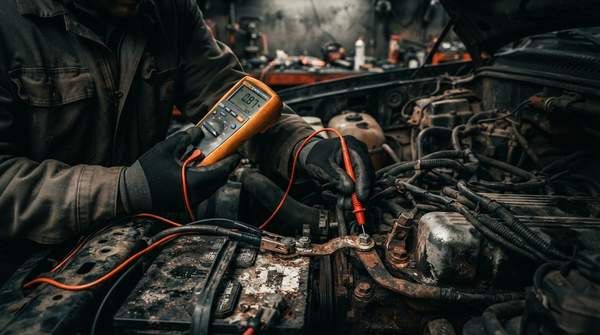
Cutaway view of an internal combustion engine cylinder during the power stroke, showing the piston being driven by a controlled explosion.

Pushing an engine's compression ratio too far can cause the fuel to explode before the spark plug fires, a destructive event known as pre-ignition. This uncontrolled combustion can melt pistons or bend connecting rods, leading to catastrophic engine failure and significant repair costs. While higher compression ratios increase engine efficiency, exceeding a critical limit risks this severe damage. This tension creates a constant engineering dilemma. Therefore, future engine design will prioritize innovative materials and sophisticated fuel management systems to safely increase compression ratios, extending the practical lifespan and performance of internal combustion engines.

The Core Principle: Turning Explosions into Motion

Internal combustion engines convert fuel's chemical energy into mechanical work through controlled explosions. The engine's effectiveness in transforming energy is quantified by the non-dimensional ratio of work done to enthalpy flux: W_dot / (m_dot * q_R), per Web Mit. Pistons' linear motion translates into rotational motion via the crankshaft, delivering continuous power, as detailed by Auto Howstuffworks. Most modern engines use a four-stroke Otto cycle: intake, compression, combustion, and exhaust. The fundamental process of intake, compression, combustion, and exhaust demonstrates the critical role of precise mechanical design in harnessing explosive energy for practical power output.

The Sequential Dance of Power Strokes

An internal combustion engine operates through a precisely choreographed sequence. www1.grc.nasa.gov details six distinct Otto cycle stages: intake, compression, combustion, power, exhaust valve opening, and exhaust. This expands on the common four-stroke model by isolating critical events like exhaust valve opening. During intake, the piston draws in fuel-air. Compression follows as the piston rises, compacting the mixture. A spark ignites it, driving the piston down in the power stroke. Finally, the exhaust valve opens, and the piston expels spent gases. The precise timing of these events is paramount; even minor deviations can severely impact efficiency and engine longevity.


The Engineering Challenge: Balancing Efficiency and Risk

Engine manufacturers face a constant battle: every efficiency gain from higher compression pushes closer to catastrophic engine failure. The theoretical efficiency of an ideal Otto cycle, 1 - (1 / r_c^(gamma-1)), shows efficiency increases with compression ratio (r_c), per Web Mit. However, this theory meets a harsh engineering reality. Higher r_c significantly raises the maximum cylinder temperature (T_max). Excessive compression can cause spontaneous fuel-air ignition without a spark, occurring at an undesirable cycle point, according to Energy. This constant tension between maximizing efficiency and preventing destructive pre-ignition is a fundamental design challenge, where the pursuit of efficiency is always limited by pre-ignition's destructive potential.

Optimizing Performance: Fuel and Material Innovations

To safely boost engine efficiency, engineers develop advanced fuels and innovative materials. Higher octane fuels resist autoignition, permitting increased compression ratios without immediate pre-ignition risks. These specialized fuels enable controlled energy release under extreme pressure. Simultaneously, stronger, heat-resistant materials for components like pistons and cylinder heads manage elevated temperatures from higher compression. Advanced engine control units (ECUs) precisely time fuel injection and ignition to prevent detonation. The combined strategies of advanced fuels, innovative materials, and advanced engine control units are crucial for approaching the Otto cycle's theoretical limits while ensuring engine integrity and extending operational life, ultimately dictating the future performance envelope of ICE technology.

What are the main components of an internal combustion engine?

An internal combustion engine relies on several key components to function. These include the engine block, crankshaft, connecting rods, pistons, cylinder head, valves, and spark plugs. The engine block houses the cylinders, while the crankshaft converts the up-and-down motion of the pistons into rotational energy. Valves control the flow of air, fuel, and exhaust gases, ensuring a precisely timed cycle.

What is the difference between a 2-stroke and 4-stroke engine?

The primary difference between 2-stroke and 4-stroke engines lies in their operational cycles. A 4-stroke engine completes its power cycle in four distinct piston movements (intake, compression, combustion, exhaust) and two crankshaft rotations. In contrast, a 2-stroke engine completes its power cycle in just two piston movements and one crankshaft rotation, combining intake/compression and combustion/exhaust into single strokes. This design makes 2-stroke engines typically lighter and simpler, but often less fuel-efficient and higher polluting than 4-stroke engines.

Bottom Line

The continuous pursuit of efficiency in internal combustion engines will drive advancements in materials science and fuel technology. By Q4 2026, major manufacturers like Cummins are expected to introduce new engine platforms that leverage advanced thermal management systems and intelligent fuel delivery to achieve unprecedented compression ratios while mitigating pre-ignition risks, promising a new era of diesel and gasoline engine performance.