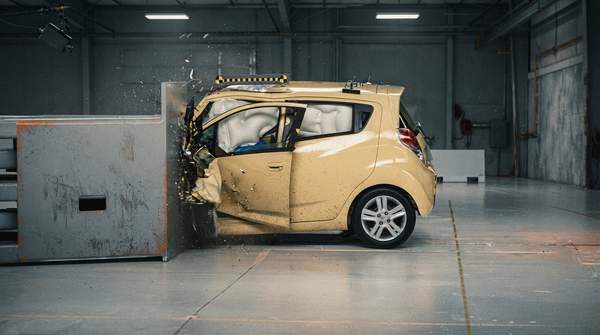
If a vehicle's suspension is engineered for 100% anti-dive, its front end remains perfectly level during hard braking. This 'anti-geometry' completely opposes the pitching moment, preventing sprung mass displacement, according to waveydynamics. Such advanced engineering challenges the common experience of cars nose-diving under deceleration, revealing a sophisticated design often overlooked.
Many drivers view wheel alignment as a routine tire service. However, it is a precise engineering discipline profoundly impacting vehicle dynamics and safety. The gap between technical reality and public understanding often leads to inadequate maintenance.
Understanding modern alignment principles is crucial for optimal performance and longevity. Professional, data-driven alignment directly enhances safety, fuel economy, and tire life.
Modern Vehicle Alignment: Beyond the Basics
Modern vehicle alignment involves intricate calibration of multiple suspension angles, dictating road interaction. It moves beyond straight wheels to optimize handling and stability under various conditions. Precise adjustment of parameters like camber, caster, and toe influences steering response, tire wear, and vehicle behavior.
Camber is the wheel's inward or outward tilt from the front. Caster describes the steering axis angle relative to a vertical line from the side. Toe is the wheel's inward or outward turn from above. Each parameter is critical for a vehicle's designed performance and safety.
The Science of Alignment Angles
Optimal alignment stems from data-driven engineering, not intuition or visual checks. A design of experiments captured parameters influencing wheel alignment, according to ninercommons. A rigorous approach ensures each adjustment contributes to the vehicle’s intended dynamic response.
Treating alignment as a simple, static adjustment is a dangerous oversimplification. Many vehicles may not perform to engineered safety and handling specifications without this precision. The sophisticated engineering, including features like anti-dive, demands a new standard of alignment service for modern vehicles.
Alignment Evolution: Simple to Sophisticated
Alignment techniques have advanced significantly with vehicle technology. As automobiles incorporate complex suspension systems and integrated driver-assist technologies, alignment precision demands have evolved. Older, less precise methods are insufficient. The shift to laser-guided systems and advanced diagnostic software ensures technicians measure microscopic deviations. The shift to laser-guided systems and advanced diagnostic software ensures technicians measure microscopic deviations. The shift to laser-guided systems and advanced diagnostic software manages dynamic forces as intended, crucial for performance and safety within original design parameters.
Precision Alignment: Critical for Your Drive
Neglecting professional, precision alignment compromises a vehicle's designed safety features, especially during critical braking. Precise suspension geometry, like 100% anti-dive, depends on accurate alignment. When parameters are off, stability and control suffer. Proper alignment enhances safety, fuel efficiency, and extends tire life. Conversely, incorrect alignment causes premature tire wear, compromised handling, and increased accident potential. Professional services restore dynamic performance and safety.
Alignment Questions Answered
What are the benefits of modern wheel alignment?
Modern wheel alignment extends tire life, improves fuel economy, enhances steering responsiveness, and reduces driver fatigue. It also ensures proper function of advanced driver-assistance systems (ADAS) by maintaining sensor calibration.
How often should I get my car alignment checked?
Experts recommend checking alignment every 12,000 to 15,000 miles, or at least annually. Check it after replacing suspension components, hitting a significant pothole, or any impact affecting steering or suspension.
What is the difference between 2-wheel and 4-wheel alignment?
A 2-wheel alignment adjusts only front wheels, common for vehicles with solid rear axles. A 4-wheel alignment adjusts both front and rear axles, essential for vehicles with independent rear suspensions to ensure all four wheels are parallel and square to the chassis.
The Unseen Engineering
The automotive service industry must adopt these advanced techniques for increasingly complex vehicles. By Q4 2026, specialized alignment centers utilizing laser-guided systems and dynamic testing protocols will likely be essential for maintaining optimal vehicle performance and safety across all vehicle types.