
DEKRA in Germany has produced data showing that electronic system failure rates are a significant and growing concern for modern vehicles. This data, published by Citainsp, indicates a rising trend of issues with electronically controlled systems, affecting vehicle reliability and driver safety. For vehicle owners, this translates into unexpected malfunctions and potentially higher repair costs for integrated electronic components, making modern vehicle electrical system principles and diagnostics in 2026 a critical area for understanding.
Modern vehicles are essentially moving computers with intricate electronic systems, but many diagnostic methods still rely on basic electrical checks that miss systemic issues. This creates a critical gap, as traditional voltage-based diagnostics prove increasingly obsolete in addressing software-driven failures. The most counterintuitive finding is the stark contrast between the acknowledged 'moving computer' complexity of modern vehicles and the continued emphasis on basic, single-point voltage checks as primary diagnostic indicators, suggesting a widespread underestimation of the problem's depth.
As vehicles continue to integrate more advanced electronics, the ability to accurately diagnose and repair these complex systems will become a critical differentiator for vehicle longevity, safety, and overall cost of ownership. This shift demands new approaches to understanding complex automotive electronics.
Your Car: A Computer on Wheels
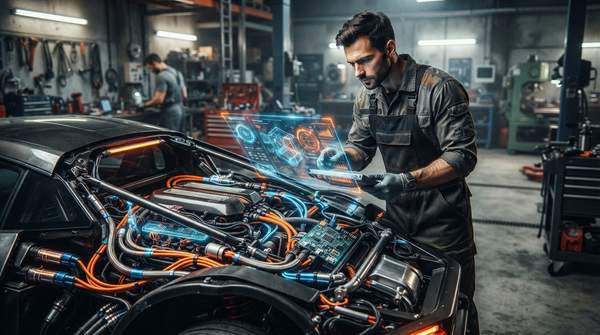
Today's vehicles incorporate sophisticated electronic control units (ECUs) and communication networks. Modern cars are essentially moving computers, according to Laflamme's Auto. This transformation means that diagnosing vehicle issues now requires understanding software and networked components as much as, if not more than, traditional wiring. Mechanics without updated equipment and training risk misdiagnosing complex problems, affecting vehicle reliability and safety.
The evolution from simple electrical circuits to integrated electronic systems means that components communicate digitally. This interconnectedness allows for advanced features like adaptive cruise control and automated parking. However, it also introduces new failure points related to software glitches or network communication errors. Diagnosing these issues requires specialized tools beyond a basic multimeter, demanding a new diagnostic paradigm.
Beyond the Basics: Understanding Core Electrical Health
Even with complex electronic systems, foundational electrical health indicators remain crucial. A healthy battery should show around 12.6 volts when the engine is off, according to HTC Auto Repair. This initial check confirms the primary power source is stable before deeper diagnostics begin, ensuring the vehicle's basic power supply is sound.
While the engine runs, the battery voltage should maintain between 13.5 and 14.5 volts, according to HTC Auto Repair. This range verifies the alternator's charging output. An alternator delivering less than 13 volts or more than 15 volts indicates a problem, potentially affecting all connected electronic systems. Based on DEKRA's data on electronic system failure rates, the automotive industry's continued reliance on rudimentary voltage checks (according to HTC Auto Repair) for complex 'moving computers' (according to Laflamme's Auto) is actively contributing to an underdiagnosed crisis of vehicle reliability and safety.
The Critical Role of Electronic Management Systems
Advanced electronic systems are now central to vehicle safety and operation. The Battery Management System (BMS) ensures electric vehicle (EV) safety and optimum operation, according to Mdpi. This system monitors cell voltage, temperature, and current flow, preventing overcharging or deep discharge, which is vital for battery longevity and performance.
The BMS in EVs exemplifies how specialized electronic components are now central to a vehicle's core function, safety, and efficiency, making their proper diagnosis paramount. A malfunction in the BMS could lead to reduced range, battery damage, or even thermal events. The critical role of systems like the BMS (Mdpi) in EV safety underscores that a failure to shift from basic electrical troubleshooting to integrated system-level diagnostics will render many mechanics incapable of safely maintaining the next generation of vehicles.
These systems operate far beyond what basic voltage readings can assess. They require specialized scan tools to read fault codes, live data streams, and perform bidirectional controls. Without these advanced diagnostic capabilities, technicians cannot accurately pinpoint the root cause of many electronic failures, leaving drivers at risk.
Common Questions About Vehicle Electronics
How do I diagnose a car electrical problem?
Initiate diagnostics with a visual inspection for obvious damage to wiring or connections. Next, use a digital multimeter to check battery voltage and continuity across fuses. For modern vehicles, a specialized scan tool is essential to retrieve diagnostic trouble codes (DTCs) from the vehicle's various control modules and analyze live data streams, which reveals deeper electronic system faults that simple voltage checks miss.
What are the common electrical issues in modern cars?
Beyond traditional battery and charging system failures, modern cars frequently experience issues with complex components like body control modules (BCMs), anti-lock braking system (ABS) sensors, and network communication errors on the CAN bus. These can manifest as intermittent dashboard warning lights, erratic component behavior, or complete system shutdowns. Software updates are often required to resolve these electronic glitches, highlighting the shift in diagnostic needs.
How to test automotive electrical components?
Testing components requires specific tools beyond a multimeter. For example, an oscilloscope can measure signal waveforms from sensors (like crankshaft position sensors) to detect subtle timing or amplitude issues. Load testers verify the capacity of batteries and alternators under working conditions. Advanced diagnostic software can also perform functional tests on actuators and modules, checking their response to commands and ensuring proper operation.
Navigating the Future of Vehicle Diagnostics
The shift towards 'moving computers' with complex electronic systems demands an evolution in diagnostic practices. Mechanics must move beyond rudimentary voltage checks and invest in advanced training and specialized diagnostic tools. This includes understanding network communication protocols and software-driven failures, which are increasingly common in 2026 models.
Proactive learning and seeking specialized expertise are essential for maintaining reliability and safety in an increasingly electronic automotive world. Vehicle owners should prioritize professional maintenance from technicians equipped to handle these intricate systems. General mechanics without updated equipment, and DIY enthusiasts relying on basic tools, are likely to face unexpected electronic failures and costly repairs.
By 2026, the demand for technicians proficient in advanced electronic diagnostics will intensify. Companies like Bosch and Snap-on continue to develop sophisticated diagnostic platforms, but widespread adoption and technician training remain critical for the industry to address the escalating complexity of vehicle electrical systems.


