Every home disposes of wastewater one of two ways: through a private septic system that treats it on your property, or through a connection to a municipal sewer that carries it to a centralized treatment plant. Which one you have determines who fixes it when it fails, what you pay and when, and what you may safely flush down the drain. The quickest check is often your water bill: a line item for "sewer service" or "wastewater treatment" signals a municipal connection, while its absence — combined with visible tank lids or a drain field in your yard — points to septic.
Understanding Your Home's Wastewater System: Septic vs. Sewer
Municipal sewers collect wastewater from homes, businesses, and industries through underground pipes and deliver it to a treatment plant, after which the treated water is reused or discharged to surface or ground water, as the U.S. Environmental Protection Agency describes centralized wastewater treatment. The homeowner's involvement essentially ends at the pipe.
A septic system, by contrast, is a self-contained treatment works on your own land. Wastewater flows into a buried tank where solids settle and beneficial bacteria break down waste, and liquid effluent disperses into soil through a drain field. As plumbing contractor guides put it, the core difference comes down to where your wastewater goes and who is responsible for managing it.
Sewer service is common in cities and towns where mains reach every property; septic systems dominate where they don't. HRI Plumbing, a North Carolina firm, notes that about 23% of that state's households use septic systems, with similar patterns across rural and semi-rural Midwest communities. This article covers conventional septic systems and standard municipal connections — not advanced designs such as mound systems or aerobic treatment units — and costs are typical ranges, not quotes for any specific region.
Your Wastewater System: A Homeowner's Diagnostic Framework
Work through these four checks in order. Each one narrows the diagnosis, and together they give a definitive identification that tells you which set of responsibilities applies to your property.
| Step | Check | What a sewer connection looks like | What a septic system looks like |
|---|---|---|---|
| 1 | Water bill | Line item for "sewer service" or "wastewater treatment" | No sewer charge on the bill |
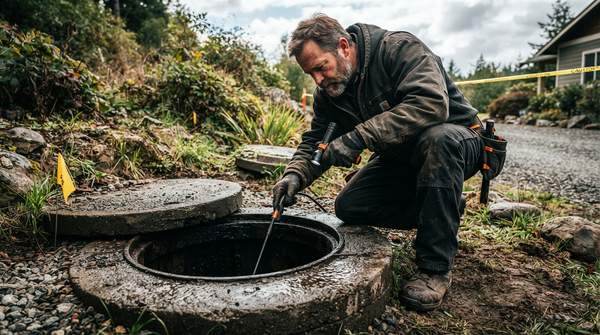
| 2 | Yard inspection | Everything underground; perhaps a small cleanout cap near the house | Large lids, a vent pipe, or a distinct drain field area |
| 3 | Public records | County or city records show a municipal connection | Records show a septic permit or tank location |
| 4 | Pipe direction | Pipe runs toward the street (or a sewer meter exists) | Pipe heads toward an open area of the yard |
Writing for TankFindr, a tank-locating service, the author recommends starting with the bill because it is usually the fastest and most definitive method: a sewer line item means municipal service, full stop. If your bill shows no sewer charge, move to the yard. Sewer systems leave nothing visible except possibly a cleanout cap; large lids or a distinct field mean septic.
If both checks are ambiguous — an unusual layout, or a shared bill — county or city governments keep detailed records on every property, so a records request settles it. Finally, if you can trace the main drainpipe's path, a pipe heading toward the street suggests the municipal main, while a pipe heading toward open yard space heads to a tank. Local regulations or unusual property configurations can still complicate the picture, in which case your local health department is the right call.