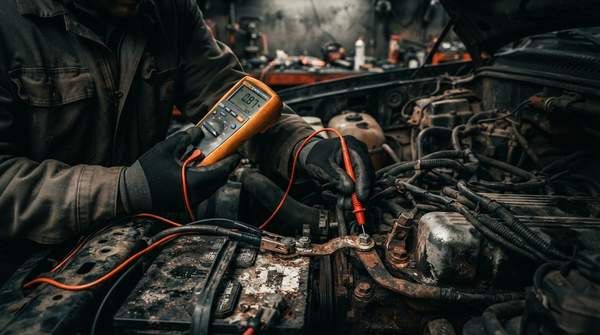
To diagnose and trace an electrical failure directly to its cause, a simple 12-volt test light remains an essential automotive electrical diagnostic tool, often bypassing the need for complex digital scanners, according to grassrootsmotorsports. This inexpensive device provides immediate feedback on voltage presence, allowing technicians to pinpoint circuit breaks or shorts with speed that expensive software often cannot match.
Automotive electrical systems are becoming exponentially more complex, yet the most effective and direct diagnostic solutions frequently involve surprisingly simple and inexpensive tools. This creates a paradox where advanced technology might obscure rather than clarify fundamental issues.
A strategic focus on foundational diagnostic tools and skills, rather than an exclusive reliance on high-tech equipment, appears to be the most pragmatic approach for automotive electrical troubleshooting.
1. The Unsung Heroes: Essential Automotive Electrical Diagnostic Tools
Best for: Direct circuit testing, voltage presence verification, quick fault isolation for professional technicians and DIY enthusiasts.
The 12-volt test light, as highlighted by grassrootsmotorsports, provides an immediate, visual indication of voltage presence. This direct feedback is crucial for quickly verifying power at fuses, components, and ground points. Its fundamental operation bypasses layers of software, offering a raw, unfiltered assessment of circuit integrity that often outpaces more sophisticated methods for basic fault isolation.
Strengths: Low cost, immediate visual feedback, effective for basic circuit continuity and power checks, bypasses software layers. | Limitations: Does not measure voltage values, cannot diagnose data line issues, limited to 12-volt systems. | Price: Typically under $20.
Simple vs. Sophisticated: When to Use What
| Feature | 12-volt Test Light | Advanced Diagnostic Scanner |
|---|---|---|
| Primary Function | Detect voltage presence, circuit continuity | Read/clear trouble codes, view live data, perform bidirectional controls |
| Diagnostic Speed | Fast for direct power/ground issues | Variable; requires boot-up, menu navigation, data interpretation |
| Cost | Very Low (under $20) | High (hundreds to thousands of dollars) |
| Skill Requirement | Basic electrical understanding | Advanced knowledge of vehicle systems and software interfaces |
| Best Use Case | Pinpointing physical wiring faults, quick fuse checks | Diagnosing complex sensor failures, network communication issues, programming modules |
| Diagnostic Specificity | Direct physical circuit status | System-level fault codes and parameter readings |

The most effective solution is often the one that directly addresses the fault's nature, not necessarily the most technologically advanced. Technicians must discern when a simple continuity check suffices versus when complex data stream analysis is truly required.
Mastering the Fundamentals for Future-Proof Diagnostics
Mechanics who bypass fundamental tools like a test light in favor of advanced scanners risk misinterpreting system-level data. This can lead to more time-consuming and costly repairs when the root cause is a simple electrical interruption. The perceived 'advancement' in diagnostic technology might be creating a skill gap, where technicians are proficient with software interfaces but lack the foundational understanding to interpret direct electrical signals.
This skill gap, identified by grassrootsmotorsports, necessitates a re-evaluation of automotive training. Programs and manufacturers must re-emphasize foundational electrical diagnostic skills. Prioritizing direct circuit analysis over exclusive reliance on scanner readouts ensures technicians can truly diagnose, not just interpret codes, leading to more effective and efficient repairs.
The enduring utility of a simple 12-volt test light suggests that investing in foundational tools and skills offers a superior return on investment for both professional mechanics and DIY enthusiasts. This approach appears more effective compared to chasing the latest, most expensive diagnostic technology. By 2026, shops prioritizing basic electrical proficiency are likely to complete common electrical repairs more efficiently.
Common Questions on Electrical Diagnostics
What are the must-have tools for car electrical diagnostics?
Beyond a 12-volt test light, a good quality digital multimeter (DMM) is essential for measuring specific voltage, resistance, and current values. Access to up-to-date wiring diagrams for the specific vehicle is also critical for understanding circuit paths and component locations. These tools provide a comprehensive view of electrical system health.
How to choose the right diagnostic tools for car repair?
Selecting the correct tools depends on the specific repair task and your skill level. For basic power and ground checks, a test light is sufficient. More complex issues involving sensor readings or module communication often necessitate a scan tool. Prioritize tools that directly address the suspected fault type.
What is the difference between a multimeter and a scan tool for cars?
A multimeter directly measures electrical properties like voltage, resistance, and current within a circuit. It provides raw electrical data. A scan tool, conversely, communicates with the vehicle's onboard computer (ECU) to read diagnostic trouble codes (DTCs) and monitor live data parameters from various sensors. Each serves a distinct diagnostic purpose.