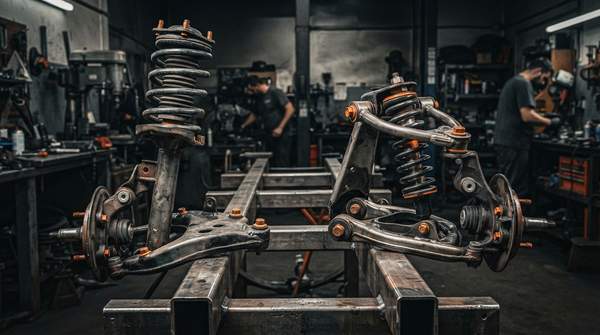
Understanding the fundamental differences between MacPherson strut and double wishbone suspension systems is crucial for automotive enthusiasts and DIY mechanics looking to grasp vehicle dynamics, handling characteristics, and potential modification impacts. While both are independent suspension types, their distinct mechanical designs lead to significant trade-offs in performance, space utilization, cost, and weight. The MacPherson strut, known for its simplicity and compact design, integrates the shock absorber and coil spring into a single unit, making it a popular choice for mass-market vehicles. In contrast, the double wishbone system, with its two separate control arms, offers superior control over wheel geometry, often favored in performance and luxury applications.
MacPherson Strut: Design and Operational Principles
The MacPherson strut is an independent suspension system that combines the shock absorber and coil spring into a single structural unit, known as the strut assembly. This assembly typically includes the shock absorber, coil spring, and an upper strut mount, as detailed by MechBasic.com's suspension overview. In many front-wheel-drive vehicles, this strut also functions as a steering pivot. The design, refined by Earle S. MacPherson, is characterized by its simplicity, with the strut pivoting at its top mount and guided by a single lower control arm. This integrated approach means the strut itself is a primary load-bearing component, contributing to the system's compact nature. While efficient, this design inherently limits the precision of wheel geometry control, particularly camber changes during suspension travel, as noted by MechBasic.com. The system's efficiency and reduced component count contribute to lower manufacturing costs and simplified maintenance procedures, making it dominant in economy and mid-range vehicle segments, especially for front-wheel-drive platforms, according to 7zap.com's technical comparison.Double Wishbone: Design and Operational Principles
The double wishbone suspension system, also an independent design, utilizes two wishbone-shaped control arms—an upper and a lower—to precisely control wheel movement. Unlike the MacPherson strut, the spring and shock absorber are typically mounted separately from the control arms. This configuration creates a four-bar linkage that allows for highly precise prediction of wheel motion, as explained by EngineerMD.com's comparison. The two control arms provide independent control over multiple suspension parameters, including camber, caster, and toe, throughout the wheel's travel. This precise control enables engineers to maintain an optimal tire contact patch, even during aggressive cornering, by producing increasing negative camber as the wheel compresses. The design also offers excellent anti-dive and anti-squat geometry, contributing to predictable handling and stability. The ability to precisely tune parameters like roll center height, camber, caster, and toe makes the double wishbone system highly adaptable for optimized component strength and performance, according to EngineerMD.com.