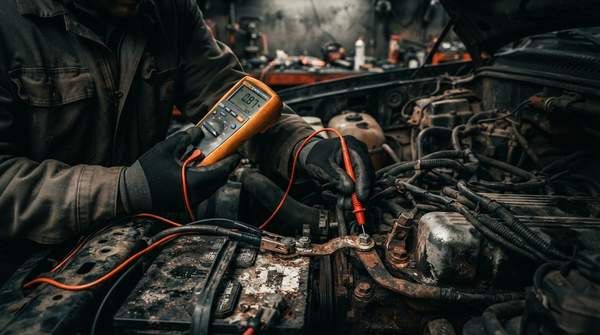
A $29 Vgate iCar Pro OBD2 scanner can indicate a basic fault code, but it cannot measure the essential equipotential bonding of an EV's high-voltage battery. Performing this critical safety check requires a specialized milliohmmeter, a tool that operates on an entirely different scale of precision and cost. Relying solely on basic scanners for complex issues risks overlooking severe underlying problems, potentially compromising vehicle safety.
Basic, affordable OBD scanners offer a convenient entry point into EV diagnostics, but the inherent complexity and high-voltage nature of electric vehicles demand far more specialized and costly tools for thorough and safe maintenance.
As EV adoption grows, a bifurcated market for diagnostic tools will emerge, with a clear distinction between consumer-friendly monitoring devices and professional-grade electrical safety and performance testers. The emergence of a bifurcated market for diagnostic tools creates a higher barrier to entry for comprehensive DIY maintenance, making specific diagnostic tools for electric vehicle maintenance critical by 2026.
The Cost of Clarity: From $29 to Professional Grade
- $29 — The Vgate iCar Pro is the most affordable option, suitable for occasional use and basic OBD2 functions, though not recommended for Tesla or advanced diagnostics, according to Voltchek.
- $39 — The Veepeak OBDCheck BLE+ is presented as a strong value EV scanner, suitable for regular monitoring and budget-conscious buyers.
- $139 — The OBDLink MX+ is recommended as the best overall EV scanner, requiring a compatible app such as Scan My Tesla, LeafSpy, or Car Scanner.
These price points highlight an accessible entry for EV owners to monitor basic vehicle health. However, their affordability often comes with limitations for deeper, safety-critical diagnostics, creating a false sense of comprehensive coverage regarding a vehicle's high-voltage systems.
Beyond the Basics: Specialized Tools for EV Integrity
1. EV-specific scan tools (Balticdiag)
Best for: Professional workshops and advanced technicians diagnosing middle to high-end EV makes.
These tools are priced at 1,900.00€ and accommodate various EV models and systems, covering brands such as BMW, Mercedes-Benz, Toyota, and Tesla, according to Balticdiag. They offer deeper system access than consumer-grade devices.
Strengths: Broad compatibility with high-end EVs; advanced system access | Limitations: High cost; specialized training often required | Price: 1,900.00€
2. Hioki IR4059 Insulation Tester
Best for: Technicians performing high-voltage system safety checks and verifying insulation integrity.
The Hioki IR4059 is a Bluetooth-compatible insulation tester featuring 5 ranges from 50 V to 1000 V. It includes specific safety features crucial for EV maintenance, as highlighted by Hioki.
Strengths: Essential for high-voltage safety; Bluetooth connectivity; wide voltage range | Limitations: Specialized function; not for general fault codes | Price: Not specified, but professional-grade
3. Hioki DT4261 Digital Multimeter
Best for: General electrical diagnostics, voltage, and current measurements on EV components.
This Bluetooth-compatible digital multimeter features terminal shutters to prevent incorrect test lead insertion, protecting against overvoltage and electrical shock. It offers a DC voltage range from 600.0 mV to 1000 V, according to Hioki.
Strengths: High safety features; wide voltage range; versatile for electrical testing | Limitations: Not EV-specific for fault codes; requires user expertise | Price: Not specified, but professional-grade
4. Hioki RM3548-50 Milliohmmeter
Best for: Verifying equipotential bonding and low-resistance measurements in high-voltage battery packs.
The Hioki RM3548-50 is a portable 4-terminal DC milliohmmeter designed for equipotential bonding tests. It features a resistance range of 3 mΩ to 3 MΩ and a testing current from 500 nA to 1 A, as detailed by Hioki.
Strengths: Critical for high-voltage system safety; precise low-resistance measurement | Limitations: Highly specialized; not for general diagnostics | Price: Not specified, but professional-grade
5. Hioki FT3701 Infrared Thermometer
Best for: Diagnosing thermal issues in EV batteries, motors, and charging systems without direct contact.
This infrared thermometer measures surface temperature across a range of -60.0 ℃ to 760.0 ℃, according to Hioki. It helps identify overheating components, which can be critical in EV maintenance.
Strengths: Non-contact temperature measurement; wide temperature range; useful for thermal analysis | Limitations: Does not diagnose electrical faults directly; limited to surface temperature | Price: Not specified, but professional-grade
While consumer scanners offer convenience, they provide no insight into the critical high-voltage electrical systems that define electric vehicles. Ignoring professional-grade tools for these systems risks catastrophic failure and severe safety hazards.
Choosing Your Diagnostic Arsenal: Consumer vs. Professional
| Feature | Basic OBD Scanners (e.g. Vgate iCar Pro) | App-Driven EV Scanners (e.g. OBDLink MX+) | Specialized Electrical Tools (e.g. Hioki RM3548-50) |
|---|---|---|---|
| Primary Function | Read/clear basic engine fault codes, live data streams | Access brand-specific data (battery health, charging stats) | Measure high-voltage insulation, bonding, precise resistance |
| Cost Range | $29-$50 | $100-$200 (plus app costs) | Hundreds to thousands of dollars |
| High-Voltage Safety Focus | None | None | Essential for verifying electrical safety and integrity |
| Diagnostic Depth | Limited to powertrain and basic OBD2 systems | Comprehensive within specific EV software; telemetry | Deep electrical system analysis, safety compliance |
| User Expertise Required | Low to moderate | Moderate | High (often professional training) |
The choice of diagnostic tool hinges on the depth of analysis required and the inherent safety considerations when working with high-voltage EV components. Consumer-grade devices provide convenience for surface-level monitoring, but they fall short in critical safety assessments, potentially leading to costly damage or injury from misdiagnosed high-voltage faults.
The Imperative of Informed EV Maintenance
The market's proliferation of affordable OBD scanners, like the $29 Vgate iCar Pro, risks misleading EV owners into believing they can safely manage their vehicles' complex electrical systems. In reality, critical safety checks require specialized tools costing potentially hundreds or thousands more, as exemplified by Hioki's professional-grade equipment. Companies marketing "comprehensive" EV diagnostic apps and scanners, such as the OBDLink MX+ with Scan My Tesla, are inadvertently fostering a dangerous illusion of DIY capability. These tools entirely bypass the essential high-voltage safety measurements that Hioki's insulation testers and milliohmmeters are designed to perform, leaving a gaping hole in safe maintenance practices.
A balanced diagnostic approach, combining accessible monitoring with specialized high-voltage safety equipment, will likely become the industry standard as EV adoption matures.