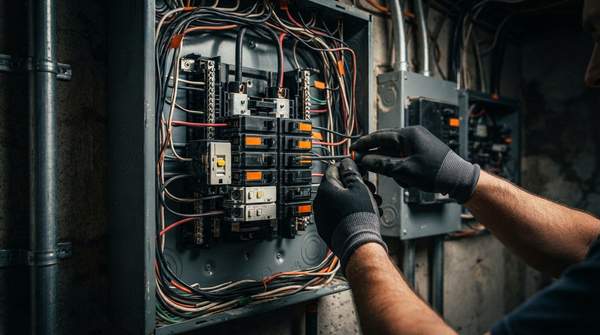
Residential circuit breakers come in four main types—standard thermal-magnetic, GFCI, AFCI, and dual-function AFCI/GFCI—and each one guards against a different electrical hazard. A standard breaker stops overloads and short circuits, a GFCI breaker protects people from shock in wet locations, an AFCI breaker protects wiring from fire-starting arc faults, and a dual-function breaker combines both GFCI and AFCI protection in a single device. Choosing the right one for a kitchen, bathroom, or bedroom depends on which hazard is most likely in that space, and on what your panel manufacturer approves.
Why Electrical Safety Matters: The Role of Circuit Breakers
Every home's electrical system depends on circuit breakers to detect fault conditions and cut current before damage or injury occurs. As breaker manufacturer CHINT explains, these devices "can detect electrical fault conditions (e.g., short circuit or overload) promptly and cut the current flow." But not every breaker detects the same fault. An electrical contractor's guide from AJ Long Electric puts it plainly: "different types provide different protections and are required in different locations."
That distinction matters because the hazards themselves are different. Overheated wires cause fires; stray current through a human body causes fatal shocks; and arcing—electricity jumping across a gap—generates extreme heat that can ignite nearby material. No single detection method covers all three. Understanding which breaker senses which fault is the foundation for choosing correctly, and it is why modern electrical codes call for more than the basic breaker in many rooms.
Understanding Common Electrical Hazards
Overloads occur when a circuit carries more current than its rating allows—for example, when too many devices are plugged into one outlet and the total load exceeds a 15- or 20-amp branch circuit. Underwriters Laboratories, in its overview of arc-fault circuit interrupters, notes that the branch circuit overcurrent protective device will open the circuit "before damage to equipment or a fire occurs" in that situation.
Short circuits happen when current takes an unintended low-resistance path, bypassing the normal load. Both overloads and short circuits are overcurrent events, and a standard thermal-magnetic breaker handles them by tripping when current exceeds a safe level.
Ground faults are different: current escapes its intended path and flows through a grounded surface—potentially a person. This is the shock hazard that GFCI breakers address by tripping quickly when they detect an imbalance in current flow.
Arc faults are the hazard standard breakers miss. UL's document emphasizes that "an OCPD is not designed to protect the circuit against arcing faults." Arcing can occur in damaged wiring or faulty cords, and it is a major fire cause. UL's standard for AFCIs, UL 1699, first published in February 1999, defines an AFCI as a device that recognizes characteristics unique to arcing and de-energizes the circuit when an arc fault is detected. AFCI designs also distinguish between arcs: a series arc occurs within a single conductor, while a parallel arc occurs between conductors. Combination-type AFCIs detect both kinds.
The stakes are real. A report citing CPSC data on electrical fires between 1994 and 1998 found that of roughly 73,500 electrical fires per year, about 82% were caused by arcs, and the CPSC estimated that AFCI technology could prevent 50–75% of residential electrical fires.
The Four Main Types of Residential Circuit Breakers
Standard (thermal-magnetic) breakers are the basic protection found in every panel. They guard against overloads and short circuits by interrupting current when it exceeds a safe level, preventing wires from overheating. They are typically found in older homes or on circuits that don't require specialized protection. Critically, this fundamental protection does not address ground faults or arc faults.
GFCI breakers detect ground faults—the shock hazards—and trip quickly when they sense an imbalance in current flow. They are required in wet locations where water makes unintended current paths more likely.
AFCI breakers protect against arc faults, a leading cause of electrical fires. Per UL's standard, they recognize the unique signature of arcing and shut the circuit down. Modern AFCIs are designed to distinguish normal operational arcs, like those from a motor or a switch, from dangerous ones, which limits nuisance tripping while providing fire protection. Combination-type AFCIs detect both series and parallel arcs.
Dual-function breakers combine both AFCI and GFCI protection in one device. Siemens describes its residential dual-function breakers as combining Class A 5mA GFCI protection with AFCI protection, integrating both into a single device where two separate devices were traditionally required.
Circuit Breaker Selection Guide for Your Home
The table below categorizes each breaker type by the fault it detects and maps that protection to the residential areas where the hazard is most likely, based on code-related guidance from these sources.
| Breaker Type | Primary Hazard Protected | How It Works (Simple) | Common Home Locations |
|---|---|---|---|
| Standard (Thermal-Magnetic) | Overloads and short circuits | Trips when current exceeds a safe level, preventing wire overheating | Every panel; typical in older homes and circuits not requiring specialized protection |
| GFCI | Ground faults (shock hazard) | Trips quickly on an imbalance in current flow | Wet locations |
| AFCI | Arc faults (fire hazard) | Recognizes characteristics unique to arcing and de-energizes the circuit; combination types detect both series and parallel arcs | Living areas per NEC 210.12(A): kitchens, family rooms, dining rooms, living rooms, parlors, libraries, dens, bedrooms, sunrooms, recreation rooms, closets, hallways, laundry areas, or similar rooms |
| Dual-Function (AFCI/GFCI) | Both arc faults and ground faults | Combines Class A 5mA GFCI and AFCI detection in one device | Kitchen and laundry circuits, where the NEC mandates both protections |
Two notes on reading the table. First, the AFCI room list comes from NEC 210.12(A) as quoted by electrical training provider JADE Learning, covering 120-volt, single-phase, 15- and 20-ampere branch circuits in dwelling units. Second, the NEC's kitchen and laundry mandate for dual protection is described by Siemens; the code text itself allows several compliance methods, so a kitchen circuit may alternatively use separate AFCI and GFCI devices.
Choosing the Right Breaker: Compatibility Is the Safety-Critical Step
Once you know which type a circuit needs, the second question is which specific breaker your panel accepts. A guide to breaker brands and compatibility by James Leichter stresses "the importance of using manufacturer-approved breakers and understanding the difference between physical fit and true electrical compatibility." A breaker that plugs into your panel is not necessarily approved for it, and installing an unapproved breaker can itself be a hazard.
Practically, this means checking your panel's approved breaker list before buying. Major manufacturers sell distinct series—such as Eaton BR, Siemens QP, and Square D HOM—and breakers are generally not interchangeable across those lines. You can also identify breaker types visually: GFCI and AFCI breakers carry test buttons on their faces, while standard breakers do not. If a breaker has a test button, its label will tell you whether it provides ground-fault, arc-fault, or both protections.
This guide covers standard 120V/240V residential plug-in breakers only, not commercial or industrial equipment. It is also not a substitute for your local electrical code, which can amend or exceed NEC requirements, and it does not provide legal interpretation of the NEC. For compliance questions, consult a qualified electrician.
Making Informed Choices for Electrical Safety
Homeowners and DIYers should always verify the specific type of circuit breaker required for each circuit in their home, considering both the electrical hazards present and local electrical codes, and ensure brand and panel compatibility before any installation. Match the hazard to the room: standard protection for basic overcurrent, GFCI where water and shock risk meet, AFCI throughout living spaces, and dual-function where both arc and ground fault dangers coexist.
The measurable indicator that your choices are correct is the presence of correctly installed and compatible circuit breakers—standard, GFCI, AFCI, or dual-function—in all required residential locations, confirmed by visual inspection and proper functioning, including GFCI and AFCI test buttons that trip when pressed. If a test button fails to trip the breaker, or a required location lacks the right protection type, that circuit is your next concrete item to address with a qualified electrician.
Sources
- Selecting the Appropriate Circuit Breaker for Residential and Industrial Applications — Chintglobal
- Circuit Breaker Types: Standard, AFCI, GFCI & More — AJ Long Electric
- CODE Authorities
- COZEN
- Dual Function Circuit Breakers (AFCI & GFCI) — Siemens
- Combination Arc-Fault Circuit-Breaker VS. Dual Function: Arc-Fault/GFCI Circuit-Breaker — Jadelearning
- Electrical Circuit Breakers – The Ultimate Guide to Brands and Compatibility — Best Flat Rate Pricing Software | Flat Rate Plus Online®