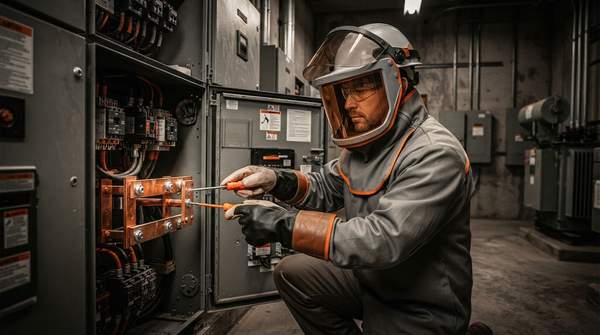
NFPA 70E defines four arc flash PPE categories, each tied to a minimum arc rating: Category 1 at 4 cal/cm², Category 2 at 8 cal/cm², Category 3 at 25 cal/cm², and Category 4 at 40 cal/cm². Each category requires a specific set of arc-rated clothing and protective equipment, escalating from a basic face shield and leather gloves at Category 1 to a full arc flash suit with hood at Categories 3 and 4. Knowing which category applies to a task—and what gear that category demands—is the difference between adequate protection and a gap in your safety program.
Introduction to NFPA 70E and Electrical PPE
The NFPA 70E standard establishes a systematic approach to electrical safety through four PPE categories based on incident energy analysis, with each category corresponding to specific arc flash hazard levels and mandating minimum protective equipment. The 2024 edition of the standard continues to refine these categories to give workers clear guidance for protecting themselves against thermal hazards from arc flash incidents, according to electrical contractor Delta Wye Electric.
Two boundaries matter before selecting any gear. Arc-rated PPE becomes a requirement when worker exposure meets or exceeds 1.2 cal/cm² of incident energy, which represents the threshold for a second-degree burn, as safety guidance from Graceport explains. PPE serves as the final protective measure within the hierarchy of controls, following elimination, substitution, engineering controls, and administrative controls [1]. It minimizes the severity of injuries from an electrical incident rather than preventing the incident itself [2].
NFPA 70E Arc Flash PPE Categories: A Comparison
The table below consolidates the gear configurations for all four categories, based on the compliance table published by Graceport. Read it as an escalating ladder: as the potential incident energy rises, the minimum arc rating doubles or triples, and the required equipment shifts from everyday workwear to a full arc flash suit. One critical rule applies across every row: the arc rating refers to the complete, layered clothing system, not to any single garment on its own.
| PPE Category | Minimum Arc Rating | Arc-Rated Clothing | Other Required PPE |
|---|---|---|---|
| Category 1 | 4 cal/cm² | AR long-sleeve shirt and pants, or AR coverall | AR face shield or arc flash suit hood; hard hat; safety glasses; hearing protection; heavy-duty leather gloves; leather footwear |
| Category 2 | 8 cal/cm² | AR long-sleeve shirt and pants, or AR coverall | AR face shield with balaclava (or arc flash suit hood); hard hat; safety glasses; hearing protection; rubber insulating gloves with protectors; leather footwear |
| Category 3 | 25 cal/cm² | AR arc flash suit jacket and pants, or AR coverall plus arc flash suit | Arc flash suit hood; AR gloves or rubber insulating gloves with protectors; hard hat; safety glasses; hearing protection; leather footwear |
| Category 4 | 40 cal/cm² | AR arc flash suit jacket and pants, or AR coverall plus arc flash suit | Arc flash suit hood; AR gloves or rubber insulating gloves with protectors; hard hat; safety glasses; hearing protection; leather footwear |
Comparing the rows side by side shows where the real step-changes occur. Categories 1 and 2 share the same basic clothing—an arc-rated long-sleeve shirt and pants or an arc-rated coverall—but Category 2 doubles the required arc rating to 8 cal/cm², adds a balaclava under the face shield, and swaps heavy-duty leather gloves for rubber insulating gloves with protectors. Categories 3 and 4 then jump to a full arc flash suit with a hood, differing from each other only in the minimum rating the suit system must achieve.