If your facility needs daily upkeep—trash removal, restroom sanitizing, vacuuming—a routine janitorial contract is likely sufficient. If it involves hard floor restoration, industrial equipment, sterile environments, or periodic intensive projects, you need specialized commercial cleaning, either alone or layered on top of a janitorial agreement. The distinction matters because the two service types differ in scope, frequency, and required expertise, and contracting for the wrong one leaves your facility either under-served or overpaying for capabilities you don't use.
Understanding Commercial Cleaning: Beyond Basic Upkeep
Commercial cleaning is an umbrella term. As Nilfisk explains in its overview of commercial cleaning service types, it covers the cleanliness of businesses, institutions, and public buildings—spaces that tend to be large and heavily used. Crucially, different industries face different cleaning challenges: a distribution warehouse is mainly concerned with clearing debris and preventing slip hazards, while a pharmaceutical environment requires sterile surfaces and carefully managed sanitation processes.
That industry variation is what splits the field into two practical categories. Routine janitorial work keeps a facility presentable day to day; specialized cleaning addresses specific, often intensive or industry-mandated needs that fall outside the daily routine. JAN-PRO, a commercial cleaning franchisor, makes the same distinction from the provider side, noting that commercial cleaning services can be offered regularly or as a one-time event depending on the client's requirements.
Janitorial Services: The Foundation of Facility Cleanliness
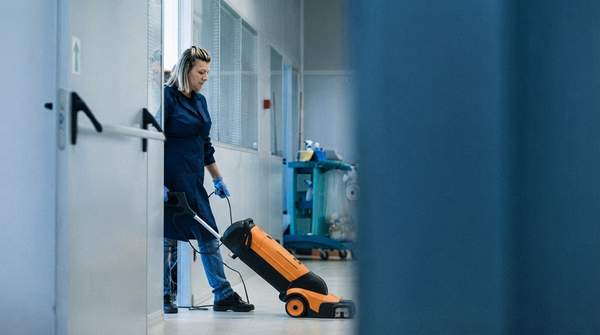
Janitorial services are the recurring maintenance layer. Red Coats, a commercial cleaning contractor, describes the typical scope as "daily recurring janitorial": routine day-porter and night-shift sanitizing of common areas, restrooms, tenant suites, and executive spaces, plus trash and recycling removal. The category also extends to interior architectural glass and partition care—lobby glass, entry doors, mirrors, and elevator enclosures—performed to keep a professional environment presentable.
Frequency is customized to the facility. JAN-PRO notes that janitorial services may be needed daily, while other businesses need cleaning outside office hours, with scheduling typically weekly or monthly depending on requirements. The expertise bar is correspondingly general: eMop, a London-based cleaning service, characterizes this kind of work as routine tasks—dusting, vacuuming, mopping, wiping—performed to maintain hygiene between deeper cleans. No hazardous material handling or heavy machinery is typically involved.
Specialized Commercial Cleaning: Addressing Unique and Intensive Needs
Specialized cleaning picks up where the routine schedule ends. Coverall, which trains commercial cleaning franchisees, points to services like contamination cleaning and upholstery and carpet care as the offerings that let commercial cleaners expand beyond routine contracts. JAN-PRO's industry examples show the same pattern from the demand side: industrial and manufacturing centers require special cleaning services for equipment and for preventing workplace accidents, while property managers need flexible cleaners for common areas, unoccupied units, and offices.
What defines this category is not the building type but the nature of the task: specific techniques, equipment, and training. JAN-PRO emphasizes that commercial cleaners often have specialized training and experience handling various commercial environments and industry-specific cleaning standards, and that commercial services tend to be more customizable because businesses have requirements unique to their industry, size, and layout. Scheduling is project-driven—one-time, monthly, or periodic—rather than a daily cadence.
Comparison: Janitorial vs. Specialized Commercial Cleaning
Use the table below as a decision boundary. Read each row against your own facility: if your needs sit mostly in the left column, a standard janitorial contract covers them; if they sit in the right column, you need a specialized cleaning arrangement, and many facilities require both.
| Dimension | Janitorial Services | Specialized Commercial Cleaning |
|---|---|---|
| Service Category | Routine, day-to-day maintenance to keep facilities clean and presentable; a subset of broader commercial cleaning. | Specific, often intensive or industry-mandated cleaning needs beyond the daily routine, including services for particular industries or unique challenges. |
| Typical Tasks | Emptying trash and replacing liners, sanitizing surfaces and restrooms, sweeping, vacuuming, mopping, cleaning common areas, and interior glass and partition care. | Hard floor maintenance, carpet and upholstery care, window cleaning, contamination cleaning, and cleaning of industrial equipment or healthcare and manufacturing facilities. |
| Typical Frequency | Daily or on a regular schedule such as weekly or monthly, customized to the facility's needs. | One-time events or less frequent cycles, driven by specific project or maintenance needs rather than daily upkeep. |
| Required Specialization | General cleaning skills and knowledge of standard products and procedures; typically no specialized equipment or hazardous material handling. | Specialized training and experience with industry-specific standards, specific techniques and equipment, and in some cases hazardous materials—expertise that matters for safety and compliance. |
Choosing the Right Service: Key Factors for Your Facility
Start with facility type. Nilfisk's framing is the cleanest guide here: a warehouse's core risks are debris and slip hazards, a pharmaceutical site needs sterile surfaces and managed sanitation, and offices, hospitals, schools, and factories each benefit from different combinations of professional cleaning. Map your building to that spectrum before you map your schedule.
Next, assess scale and complexity of operations. Coverall notes that commercial cleaning customers span offices, retail, healthcare, schools, and industrial facilities, with contracts typically awarded by property managers, facility managers, business owners, and office managers—meaning the decision-maker should match the contract to the facility's actual use patterns, not just its square footage.
Finally, check for industry-specific requirements. JAN-PRO's examples—equipment cleaning in manufacturing, sanitation-sensitive environments—show that some tasks carry safety and compliance weight, not just appearance. Where those exist, specialized expertise is not optional, and a routine janitorial provider without that training is the wrong contract regardless of price.
Making an Informed Choice for Your Facility
Business owners and facility managers should assess their facility's type, operational scale, and any industry-specific cleaning requirements to determine whether routine janitorial services, specialized cleaning, or a combination of both is necessary. In practice, most commercial facilities land on a combination: a recurring janitorial agreement for daily presentation and hygiene, plus scheduled or on-demand specialized projects—floor care, carpet cleaning, contamination response—layered on top.
The checkable outcome is the contract itself. Before signing, confirm the agreement explicitly details the tasks, the frequency, and any specialized protocols aligned with your facility's industry standards. If your facility's specific needs—daily upkeep versus periodic deep work versus regulated sanitation—cannot each be located in the written scope of that contract, the contract does not yet match your facility, and that gap is your next concrete step.
Sources
- 10 Types Of Commercial Cleaning Services — Nilfisk
- Commercial vs Residential Cleaning: What's the Difference? — JAN-PRO Cleaning & Disinfecting
- Choosing the Right Clean and Green Cleaning Services for Your Commercial Building - Red Coats — Red Coats -
- 22 Types of Cleaning: What do Cleaning Services Offer? — Blog. eMop Cleaning Services in London
- The Key Differences Between Commercial and Residential Cleaning — Coverall