While the automotive diagnostic scan tools market is projected to reach nearly $70 billion by 2033, some devices retrieve critical fault codes in just over 17 seconds, revealing a surprising performance gap. This efficiency difference directly impacts repair shop throughput and customer satisfaction, as longer diagnostic times reduce daily vehicle service capacity.
The automotive diagnostic tools market booms with significant investment, yet user utility and efficiency vary wildly by tool. This tension exists between market expansion and practical application: advanced technology does not always equate to faster core functionality.
As vehicles grow more complex and production volumes rise, demand for sophisticated, efficient diagnostic tools will intensify. Informed selection becomes critical for mechanics and DIY enthusiasts to avoid significant time and cost inefficiencies.
What Are Automotive Diagnostic Tools?
The automotive diagnostic scan tools market reached $44.72 billion in 2026, according to The Business Research Company. These tools interface electronically with a vehicle's On-Board Diagnostics II (OBD-II) system, monitoring components and systems. The market is projected to grow to $57.79 billion by 2030, with a compound annual growth rate (CAGR) of 7.2% from 2026 to 2033, reports Coherent Market Insights. These consistent growth projections confirm the increasing reliance on diagnostic tools for modern vehicle maintenance and repair globally.
Diagnostic tools range from basic code readers, which retrieve trouble codes, to advanced scan tools with live data streams, graphing, and bidirectional controls. This market expansion directly results from the automotive industry's shift to electronically controlled systems, demanding specialized equipment for accurate troubleshooting.
Beyond Basic Scanners: The Spectrum of Diagnostic Capabilities
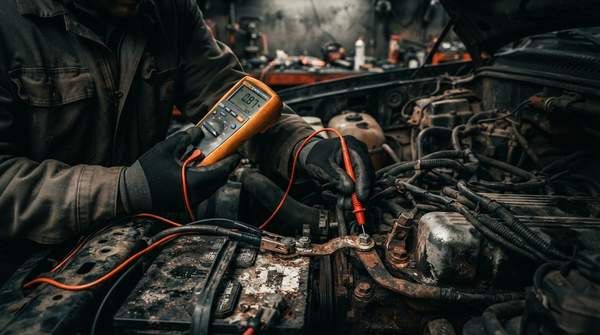
Specialized automotive oscilloscopes display all cylinders simultaneously, unlike most digital oscilloscopes that show only one ignition waveform, states Autoditex. These tools are crucial for intricate issues like 'crank-no-start' conditions, requiring detailed views of multiple sensor inputs and ignition outputs. Four-channel oscilloscopes are common for simultaneous ignition circuit views or complex electrical diagnostics. General scan tools provide fault codes and some live data, but lack the precision to analyze waveform patterns or compare multiple electrical signals concurrently. This gap mandates specialized equipment for professional technicians tackling advanced vehicle electronics, ensuring comprehensive diagnostics beyond simple error code retrieval.

The Need for Speed: Performance Disparities in Diagnostic Tools
A basic hardwired scanner, the Motopower MP69033, displayed critical fault codes in just over 17 seconds, reports Car and Driver. In contrast, the Bluetooth-enabled Ancel BD310 took 18.6 seconds via plug-in to Bluetooth, and the BlueDriver Pro Next Gen required 28.2 seconds. The Autel MaxiCOM Mk808Z-BT, a more sophisticated device, took 51.5 seconds. These results show that technological sophistication does not always translate to core diagnostic speed; simpler, hardwired devices can significantly outperform advanced, pricier Bluetooth options for basic code retrieval. Car and Driver's tests reveal repair shops investing in slower tools sacrifice operational efficiency, with some devices taking three times longer for basic code retrieval, directly impacting daily vehicle throughput.
Even small differences in scan times accumulate into significant savings or losses for mechanics and DIYers, impacting productivity and troubleshooting patience. This disparity demands better industry standards or clearer performance benchmarks within the diagnostic tool market, enabling more informed purchasing decisions.
Driving Demand: Vehicle Complexity and Production Growth
In Q2 2024, total vehicle output grew from 10.92 million units in Q1 2024 to 11.30 million units, reports The Business Research Company. This consistent increase in global vehicle production correlates directly with escalating demand for diagnostic tools, as each new vehicle adds to the installed base. The automotive diagnostic scan tools market was $42.08 billion in 2025, confirming significant financial commitment to vehicle diagnostics. The continuous rise in global vehicle production, coupled with modern automobile complexity, directly drives demand for effective diagnostic solutions.
Modern vehicles integrate more electronic control units (ECUs) and intricate sensor networks, rendering traditional mechanical troubleshooting less effective. This complexity makes diagnostic tools essential, not optional, for efficient issue resolution, driving market growth and innovation.
Common Questions About Diagnostic Tools
What are the best automotive diagnostic tools?
The best tools vary by user need; for basic code reading, a hardwired OBD-II scanner like the Motopower MP69033 offers speed. Professional technicians often require advanced bi-directional scan tools, which can activate vehicle components, or specialized oscilloscopes for in-depth electrical analysis not possible with simpler devices.
How do I use an OBD-II scanner?
To use an OBD-II scanner, locate your vehicle's 16-pin OBD-II port, typically under the dashboard on the driver's side. Plug the scanner into the port, turn the ignition to the 'on' position (without starting the engine), and follow the on-screen prompts to read fault codes or access live data streams.
What is the difference between a code reader and a scanner?
A basic code reader primarily retrieves and displays diagnostic trouble codes (DTCs) and may offer limited live data. A more advanced scanner provides expanded capabilities, including manufacturer-specific codes, live data graphing, freeze-frame data, and often bidirectional controls, allowing the user to command vehicle components for testing.
The Future of Vehicle Diagnostics
By 2028, the automotive diagnostic industry will likely integrate artificial intelligence into diagnostic platforms, enabling more predictive maintenance and faster, more accurate troubleshooting for increasingly complex vehicles, including electric models.