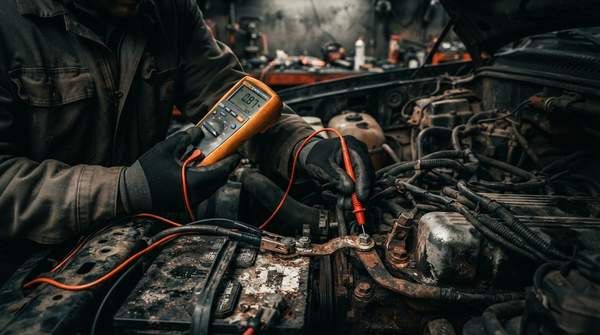
A standard digital multimeter, once a mechanic's go-to, is effectively blind to the rapid data pulses on a modern vehicle's CAN bus, only providing an unhelpful average voltage. The multimeter's limitation renders traditional diagnostic methods insufficient for complex CAN bus systems, leading to misdiagnoses and prolonged repair times. While CAN bus dramatically reduced vehicle wiring complexity and offers software flexibility, its intricate digital protocols demand advanced diagnostic tools and expertise that traditional methods cannot provide. The automotive repair industry now faces a growing divide: shops equipped for CAN bus diagnostics will thrive, others will struggle to service modern vehicles.
CAN bus technology significantly reduced vehicle wiring complexity compared to older point-to-point systems, according to Autopi. The streamlined, network-based architecture reduces weight and simplifies manufacturing by requiring fewer physical connections between Electronic Control Units (ECUs). Beyond physical simplification, CAN bus offers software flexibility. Functions like warning light triggers can be modified via software without re-wiring. This adaptability allows easier updates and customization. However, while the CAN standard defines electrical signals and message structure, message content varies between OEMs and custom builds, according to HP Academy. This creates a challenge for universal diagnostic interpretation, demanding a new approach to diagnostics for this software-defined network.
The Digital Backbone: How CAN Bus Works
A high-speed CAN bus operates with a data transfer rate of 500K bits/sec, according to Snap-on, enabling rapid communication between numerous ECUs within a vehicle. The 500K bits/sec speed is critical for real-time operations, from engine management to advanced driver-assistance systems. The network relies on two wires, CAN High and CAN Low, which transmit differential voltages to represent data bits. This differential signaling helps reject electrical noise, ensuring reliable communication even in electromagnetically noisy automotive environments.
Messages on the CAN bus are broadcast to all connected nodes, but only the intended recipient ECUs process the message based on its identifier. The message identifier also dictates message priority, allowing critical data, such as braking commands, to take precedence over less urgent information like ambient temperature readings. The system also incorporates sophisticated error detection mechanisms to maintain data integrity across the network.
When a CAN node transmits five bits of the same logic level, it must send one bit of the opposite level, a process known as bit stuffing, to ensure network synchronization, according to CSSElectronics. The bit stuffing process, a hidden layer of network management, actively modifies the bitstream, ensuring operational integrity by preventing long sequences of identical bits that could cause synchronization loss. Understanding how bit stuffing maintains network synchronization reveals a deeper complexity beyond simple data transmission, making direct interpretation of raw bitstreams more challenging without specialized tools.
Grasping these communication principles and data rates is critical for CAN network diagnosis. The rapid, digital nature of CAN communication demands a specialized approach, unlike traditional continuous voltage measurements.
Initial Diagnostic Steps for CAN Bus Systems
When approaching a vehicle with suspected CAN bus issues, the initial step involves more than just a visual inspection; it requires a systematic approach to identify the network's health. Technicians should begin by connecting a specialized diagnostic scan tool to retrieve any stored Diagnostic Trouble Codes (DTCs). These codes, while not always pinpointing the exact fault, can indicate which ECUs are experiencing communication problems or reporting errors on the network.
Following DTC retrieval, a fundamental physical layer check involves inspecting the CAN bus lines with an oscilloscope. Unlike a multimeter, which provides only an average voltage, an oscilloscope allows technicians to visualize the actual waveform of the CAN High and CAN Low signals. A healthy CAN bus signal should show clean, distinct square waves with proper voltage levels and differential signaling. Irregularities such as corrupted waveforms, inconsistent voltage levels, or excessive noise immediately indicate a physical layer issue, such as a short, an open, or interference.
Next, technicians must verify the network's termination resistance. A properly terminated high-speed CAN bus should measure approximately 60Ω across the CAN High and CAN Low lines when the ignition is off and all ECUs are unpowered. The 60Ω measurement confirms the presence and integrity of the two 120Ω termination resistors typically found at each end of the bus. An incorrect resistance reading, such as 120Ω (one resistor missing or open) or 0Ω (a short), signifies a critical physical layer fault that will prevent reliable network communication. This requires careful disconnection of ECUs to isolate the faulty resistor or wiring.
Finally, a critical step involves observing the network's behavior under operational conditions. With the vehicle powered on, an oscilloscope can reveal dynamic issues like intermittent signal drops, excessive bus load, or error frames. Observing the arbitration process, where messages compete for bus access, can also provide insight into network congestion or an ECU that is continuously transmitting, potentially monopolizing the bus. Real-time observations are indispensable for diagnosing transient faults that would be impossible to detect with static measurements alone, emphasizing the need for advanced tools and a deep understanding of CAN protocols.
Beyond the Multimeter: Diagnosing CAN Bus Issues
A digital multimeter (DMM) is ineffective for CAN bus diagnostics, providing only average voltage readings and missing rapid transients, according to Gridconnect. Relying on a DMM for CAN bus is like trying to read a fast-moving ticker tape with a still camera: only blurry averages appear, missing the actual data stream. Shops without advanced diagnostic oscilloscopes operate blind, risking misdiagnoses and prolonged repairs.
Adding to this complexity, some devices feature software-configurable termination that becomes active only when powered on, requiring a check for 60Ω across the network with all devices energized, according to Gridconnect. A simple, unpowered continuity check for termination resistance, a common practice in traditional electrical diagnostics, can yield misleading results. The network's physical state becomes dynamically dependent on its software configuration, complicating traditional diagnostic approaches and demanding live, powered network analysis to understand its active digital behavior.
Intricate digital communication protocols—arbitration, error handling, bit stuffing—detailed by Snap-on and CSSElectronics, introduce a new diagnostic complexity. CAN bus reduced physical wiring, but it exchanged visible electrical problems for abstract, software-driven network issues. The shift to abstract, software-driven network issues demands a complete paradigm shift in technician training and skill sets.
The high-speed, digital nature of CAN bus renders traditional analog tools inadequate, demanding specialized equipment and protocol-level understanding. Since the CAN standard defines electrical signals but not message content (HP Academy), and devices can have software-configurable termination (Gridconnect), manufacturers create proprietary digital ecosystems. The proprietary digital ecosystems force independent repair shops into a constant game of catch-up for diagnostic information and tools.
Mastering Modern Vehicle Diagnostics
Effective diagnosis of CAN bus systems begins with a deep understanding of message prioritization, which is governed by the arbitration field in a CAN message. This field ensures that messages with the lowest numerical identifier, representing the most dominant bits, are prioritized for bus access, according to Snap-on. Technicians must learn to interpret these arbitration processes, especially when troubleshooting a busy network where multiple ECUs may be attempting to transmit simultaneously. Identifying which messages are consistently winning or losing arbitration can pinpoint an ECU that is either malfunctioning by transmitting too frequently or one that is being consistently suppressed, indicating a deeper system issue.
Another critical aspect of mastering modern vehicle diagnostics involves understanding CAN bus error handling. The system is designed to identify and reject erroneous messages, enabling re-transmission of corrupt data and helping to disconnect nodes that consistently transmit errors, according to CSSElectronics. Robust error management is vital for maintaining network integrity, but it also means technicians must be able to differentiate between temporary communication glitches and persistent hardware or software faults. Using a CAN bus analyzer to observe error frames and their frequency can help identify which specific node is generating errors and whether the network is consistently correcting them or if a node needs isolation and repair.
Technicians must also develop the skill to interpret the dynamic behavior of the CAN bus, moving beyond static resistance checks. This includes recognizing the nuances of voltage differential, signal integrity, and message content under various operating conditions.s and understanding how different ECUs contribute to the overall network load. By observing the signal integrity under various operating conditions, such as engine cranking, idle, and during component activation, technicians can uncover intermittent faults that would otherwise remain elusive. This approach requires not just the right tools, but also a comprehensive understanding of how data flows and how errors are managed within the complex digital ecosystem of a modern vehicle.
Mastering modern vehicle diagnostics demands significant investment in specialized tools and ongoing technician training. Interpreting oscilloscope waveforms, understanding message arbitration, and analyzing error frames are no longer optional. These skills are essential for efficient, accurate CAN bus repairs, preventing repeat visits. The shift to digital troubleshooting mandates continuous learning.
What are the common CAN bus errors in vehicles?
Common CAN bus errors in vehicles include bit errors, where a transmitting node detects a different bit value than what it sent; stuff errors, caused by a violation of the bit stuffing rule; CRC errors, indicating data corruption during transmission; and acknowledgment errors, where no node confirms receipt of a valid message. Form errors occur when a message frame violates the defined CAN bus structure. These errors often point to wiring issues, faulty ECUs, or incorrect termination.
How do I diagnose a CAN bus failure?
Diagnosing a CAN bus failure involves a structured approach, starting with retrieving Diagnostic Trouble Codes (DTCs) using a specialized scan tool. Subsequently, use an oscilloscope to visually inspect the CAN High and CAN Low waveforms for signal integrity, proper voltage levels, and the absence of noise or corruption. Finally, perform a resistance check across the CAN lines with the ignition off and on to verify proper network termination, especially for systems with software-configurable resistors.
What tools are needed for CAN bus diagnostics?
Essential tools for CAN bus diagnostics include a high-quality automotive oscilloscope for visualizing signal waveforms and capturing transients, a specialized CAN bus analyzer for interpreting message content and error frames, and a reliable diagnostic scan tool for retrieving and clearing DTCs. A digital multimeter can still be useful for basic voltage checks on power and ground, but it is insufficient for diagnosing the data network itself. These tools enable technicians to move beyond basic electrical checks and delve into the intricate digital communication protocols.
By Q3 2026, independent repair shops that have not invested in advanced diagnostic oscilloscopes and comprehensive CAN bus training for their technicians will likely face significant challenges in servicing modern vehicles, potentially losing market share to better-equipped competitors.