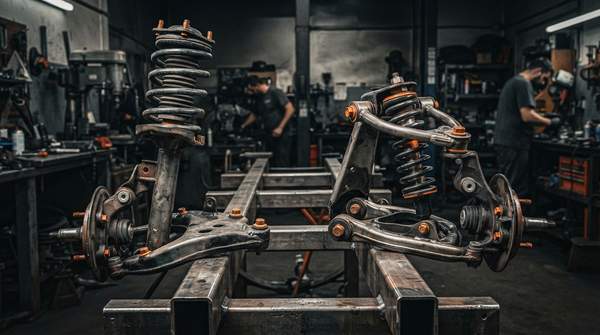
What is a vehicle suspension system and how does it work?

Operating a fully loaded car in difficult conditions can slash its suspension system's reliability by 50%, according to mdpi .

LO
Luis Ortega

June 20, 2026 · 4 min read

Detailed view of a car's suspension system flexing under stress on a rough road, illustrating its critical role in vehicle performance and safety.

Operating a fully loaded car in difficult conditions can slash its suspension system's reliability by 50%, according to mdpi. This drastically reduces vehicle control, as drivers unknowingly navigate roads with significantly compromised systems, believing their car performs optimally. This vulnerability directly compromises safety margins, turning expected performance into a significant risk under routine stress.

Vehicle suspension is designed to maximize friction, stability, and comfort, but its reliability can be halved under common challenging conditions, directly impacting road safety. The system designed for stability becomes a liability under stress, creating a dangerous gap between perceived and actual vehicle capability. Given the significant yet often overlooked impact of suspension health on vehicle safety and performance, proactive maintenance and insistence on high-quality repairs are crucial to mitigate accident risks and ensure long-term vehicle integrity.

Understanding Suspension Vulnerabilities

The 50% reliability decrease in a fully loaded car's suspension under difficult conditions, as reported by Mdpi, highlights a critical design and operational vulnerability. This isn't merely a theoretical reduction; impact load from the road significantly affects vehicle ride comfort, handling stability, safety, and tire service life, as noted by pmc.ncbi.nlm.nih.gov. Together, these factors mean that routine driving, especially with heavy loads or over uneven terrain, initiates a continuous degradation cycle. This cumulative effect on performance and safety often goes unnoticed until a critical failure occurs, making early detection paramount.

The Unsung Hero: What Your Suspension Actually Does

The vehicle's suspension system is a complex assembly, not just a comfort feature. Its core functions, as outlined by Auto, include supporting vehicle weight, absorbing and dampening road shocks, and critically, maximizing tire-to-road friction. This system ensures steering stability, precise handling, and passenger comfort by maintaining consistent tire contact, even over imperfections. This continuous, optimized grip is fundamental for effective braking and steering, directly translating to safe vehicle control.


Design Challenges: Why Perfect Suspension is Hard

Achieving optimal suspension performance involves inherent design compromises. For example, the solid axle's fundamental flaw, as Car and Driver notes, is that an impact on one wheel transmits directly to the opposite. This design choice inherently compromises independent tire contact, a critical factor for stability on uneven surfaces. Furthermore, even subtle elements like suspension friction, when accounted for during optimization, can reduce the vehicle body's vertical acceleration, according to Vehicledynamicsinternational. Achieving a balanced system requires meticulous engineering, where seemingly minor design decisions profoundly impact a vehicle's handling, stability, and passenger comfort.

Beyond Basic: How Technology Improves the Ride

Modern engineering actively addresses traditional suspension limitations. Semi-active suspension systems, for instance, demonstrably improve vehicle ride comfort and handling stability, as detailed in a study on a vehicle semi-active suspension control system. Unlike their passive counterparts, these systems dynamically adjust damping forces in real-time, adapting to changing road conditions and driver inputs. This capability marks a significant advancement, optimizing the critical balance between ride comfort and dynamic handling. The result is a more controlled and smoother driving experience across diverse terrains and driving styles, enhancing both safety and driver confidence.

The High Stakes: Suspension, Safety, and Longevity

A vehicle's suspension integrity directly dictates its long-term safety and operational lifespan. Nature reports that road accidents frequently damage car bodies, steering, and suspension systems, and critically, the quality of subsequent repairs directly impacts road safety. This implies a pervasive risk: many vehicles on the road may harbor latent safety defects due to substandard post-collision maintenance. The combined stress of daily driving and inadequate repairs means a vehicle's 'safe' status is not static; it is a dynamic variable, constantly susceptible to degradation. This transforms long-term road safety from a predictable engineering standard into an unpredictable, shifting challenge for vehicle owners.

Your Suspension Questions Answered

Understanding the fundamentals of your vehicle's suspension is crucial for informed maintenance decisions.

What are the main components of a suspension system?

A vehicle's suspension system primarily consists of springs, shock absorbers (dampers), and various linkages such as control arms and ball joints. Springs support the vehicle's weight and absorb impacts, while shock absorbers control spring oscillations, preventing excessive bouncing. Sway bars connect opposite wheels to reduce body roll during turns, enhancing stability.

What are common suspension problems and their symptoms?

Common suspension problems include excessive bouncing after hitting bumps, a noticeable pull to one side while driving, or uneven tire wear patterns. Drivers may also hear clunking or squeaking noises when going over bumps or turning. A 'nose dive' during braking or excessive body roll in corners also indicates potential suspension component wear.

How does suspension system failure impact vehicle safety?

Suspension system failure significantly compromises vehicle safety by reducing tire-to-road contact, which directly impacts braking efficiency and steering control. A compromised suspension can increase stopping distances, make the vehicle prone to hydroplaning, and lead to unpredictable handling, especially during emergency maneuvers. This increases accident risk and reduces overall driver confidence.

Suspension issues are not merely comfort nuisances but direct threats to vehicle control and occupant safety.

Drive Smarter: Prioritizing Your Suspension

The critical role of vehicle suspension, often overlooked, demands proactive attention. Investing in its health is not just about comfort; it yields significant returns in safety and extends the vehicle's operational lifespan. By 2026, the Automotive Aftermarket Suppliers Association projects continued advancements in diagnostic tools, which will simplify the identification of subtle suspension issues before they escalate into major failures. Therefore, prioritizing regular inspections and entrusting repairs to qualified service centers is essential to maintain your vehicle's engineered safety and performance standards.