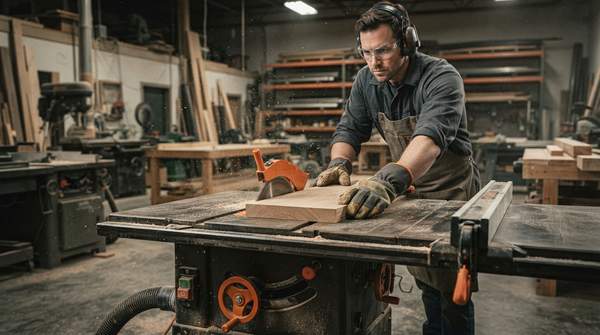
Operating power saws like circular saws, miter saws, and table saws in a workshop requires strict adherence to safety practices to prevent serious injuries. Common hazards include kickback, projectile debris, and accidental contact with the blade. Implementing a structured set of safety measures, coupled with the correct use of personal protective equipment (PPE), is crucial for enhancing workshop safety.
Understanding Power Saw Hazards: Kickback, Debris, and Contact
Working with power saws presents several significant hazards that can lead to severe injuries, including cuts, lacerations, and amputations, according to SECURA. One of the most dangerous is kickback, which occurs when the saw blade catches the material being cut and forcefully throws it back toward the operator. This can happen if the blade height is incorrect or if the blade is not properly maintained, and it is more common during ripping than cross-cutting, as noted by SECURA. The Canadian Centre for Occupational Health and Safety (CCOHS) advises standing to the side while operating a saw to avoid kickback.
Another prevalent hazard is projectile debris. When sawing timber or other materials, there is always a risk of dust, wood chips, or metal shavings flying off the surface. Evolution Power Tools USA emphasizes that these projectiles can cause eye injuries, with one study indicating that 90% of eye injuries are preventable. Additionally, loud noise generated by power saws can lead to hearing damage, making hearing protection essential. Accidental contact with the spinning blade is also a constant risk, highlighting the importance of functional blade guards and careful operation.
Critical Safety Practice 1: Always Wear Appropriate Personal Protective Equipment (PPE)
Wearing the correct personal protective equipment (PPE) is non-negotiable when operating power saws. This practice directly mitigates hazards such as projectile debris, loud noise, and dust inhalation. Evolution Power Tools USA highlights that dust, wood chips, and metal shavings are common risks that can fly off the cutting surface. To counter this, eye protection, such as safety glasses or goggles, or a face shield worn with safety glasses or goggles, is essential, according to the CCOHS. Hearing protection is also crucial, depending on the material being cut and the duration of the work, as noted by Evolution Power Tools USA.
For environments with harmful or nuisance dusts, an approved respirator or dust mask should be worn, the CCOHS advises. Beyond specific protective gear, it is important to avoid loose clothing and tie back long hair to prevent them from getting caught by the spinning blade, as recommended by Evolution Power Tools USA. While hand protection is often considered, the primary evidence emphasizes eye, hearing, and respiratory protection, along with managing loose clothing, to prevent common power saw injuries.
Critical Safety Practice 2: Prevent Kickback Through Proper Setup and Stance
Preventing kickback is a critical safety practice that directly addresses the hazard of the workpiece being violently thrown back at the operator. Kickback can occur if the blade height is incorrect or if the blade is not properly maintained, according to SECURA. To mitigate this, the CCOHS recommends setting the blade's depth so that the lowest tooth extends no more than about 0.3 cm (1/8 inch) beneath the wood. This precise blade depth helps ensure the blade cuts efficiently without excessive exposure that could snag the material.
Proper operator positioning is also vital. The CCOHS advises standing to the side while operating the saw to avoid being in the direct path of a potential kickback. Additionally, ensuring the workpiece is properly supported, clamped, or secured is crucial, as an unsecured workpiece can lead to kickback or movement that causes injury, according to an article in PMC. A rigid, level, and mounted saw, not prone to movement, further helps limit the risk of harm.
Critical Safety Practice 3: Inspect Blade Guard Functionality and Blade Condition
Regular inspection of the blade guard and the blade itself is a fundamental safety practice that prevents accidental contact with the spinning blade and injuries from blade failure. Before each use, operators should check that the retracting lower blade guard moves freely and returns to its starting position, as advised by the CCOHS. This guard is designed to enclose the blade's teeth as completely as possible and cover the unused portion of the blade during cutting, protecting the operator from the exposed blade.
In addition to checking the guard's functionality, it is essential to inspect the blade for any signs of damage, such as warping or bending. A damaged, warped, or bent blade should never be used and must be replaced immediately to prevent failure during operation, according to the CCOHS. Keeping both the upper and retracting lower blade guards clean and free of sawdust is also important to ensure they operate without obstruction. The CCOHS also notes that sharp blades work better and are safer, so ensuring the blade is sharp enough for the job is part of this critical inspection.
Critical Safety Practice 4: Maintain a Safe and Clear Work Area
Maintaining a safe and clear work area is crucial for preventing accidents such as trips, falls, and uncontrolled movement of the saw or workpiece. SECURA emphasizes that incidents from powered cutting tools have a high rate for "struck by" accidents in construction, underscoring the importance of a well-organized environment. The work area should be kept clean and free of clutter, ensuring good footing for the operator, as recommended by SECURA.
Furthermore, the saw itself should be level, rigid, and, whenever possible, rigidly mounted to prevent movement during operation, according to an article in PMC. This stability is particularly important when working with various materials. Providing sufficient workspace layout appropriate for the application also contributes to safety by allowing the operator adequate room to maneuver and manage the workpiece effectively, reducing the risk of injury from unexpected movements.
Critical Safety Practice 5: Secure the Workpiece Properly
Securing the workpiece properly is a vital safety practice that directly addresses the risk of kickback and loss of control during cutting. An article in PMC highlights that a workpiece that is not properly supported, clamped, or secured can result in kickback or movement, leading to injury. This is particularly important for common power saws like circular saws, miter saws, and table saws, where the material must remain stable throughout the cut.
For instance, when using a circular saw, the CCOHS advises against ripping stock without using a wedge or guide that is clamped or nailed to the material. This ensures the stock remains stable and prevents it from binding against the blade, which can cause kickback. By rigidly supporting and securing the material, operators can maintain better control over the cutting process, significantly reducing the likelihood of the workpiece shifting unexpectedly and causing an accident.
Power Saw Safety Checklist: Practices, Hazards, and PPE
The following checklist provides a quick reference for critical safety practices, the hazards they mitigate, and the specific PPE or actions required for common workshop power saws.
| Safety Practice | Hazard Mitigated | Specific PPE / Action |
|---|---|---|
| Wear Appropriate PPE | Projectile debris, loud noise, dust inhalation | Safety glasses/goggles or face shield (with safety glasses/goggles), approved respirator/dust mask, hearing protection. Avoid loose clothing, tie back long hair. |
| Prevent Kickback | Blade catching stock, material thrown back at operator | Set blade depth to extend no more than 0.3 cm (1/8") beneath wood. Stand to the side of the saw. Ensure proper blade maintenance. |
| Inspect Blade Guard and Blade | Accidental blade contact, blade failure | Check blade guard moves freely and returns to position. Inspect blade for damage (warping, bending); replace damaged blades immediately. Keep guards clean. |
| Maintain Safe Work Area | Trips, falls, uncontrolled saw/workpiece movement | Keep work area clean and clutter-free. Ensure good footing. Saw should be level, rigid, and mounted when possible. |
| Secure the Workpiece Properly | Kickback, loss of control, workpiece movement | Properly support, clamp, or secure the workpiece. Use wedges or guides when ripping stock. |
Enhancing Workshop Safety: A Proactive Approach
Adhering to a structured set of safety practices, including proper PPE, blade management, and work area setup, is crucial for mitigating common hazards associated with power saw operation. These practices directly address risks such as kickback, projectile debris, and accidental blade contact. To enhance workshop safety, implement the five critical power saw safety practices as a routine checklist before and during every operation. A consistent reduction in near-miss incidents and minor injuries related to power saw use, and regular verification of PPE availability and condition, will indicate improved safety.
Sources
- Mechanical saw safety — SECURA
- 7 Essential Circular Saw Safety Tips You Shouldn’t Ignore — Evolution Power Tools USA
- Powered Hand Tools - Saws - Circular — CCOHS
- SAW SAFETY Risk in the Real World - PMC