Safe chemical storage in a home or small workshop comes down to three evidence-backed rules: keep quantities small, segregate incompatible materials, and keep flammable solvents away from ignition sources. Guidance from the University of Cambridge's Occupational Health and Safety Service sets concrete limits for exactly this setting — no more than one litre of flammable solvent on the open bench, a maximum of 50 litres of flammable solvent stored in a workshop in total, and a strict rule never to store or use acids alongside bleach. This guide turns those principles into a decision framework you can apply to the chemicals on your own shelves.
Understanding Your Workshop Chemicals: Types and General Principles
Most home and small workshops hold only small quantities of hazardous chemicals, and the Cambridge guidance notes that adequate segregation and safe storage can be achieved by following its rules together with good practice and common sense. The first principle is minimisation: the less you store, the less can go wrong. The second is containment — keep all toxic chemicals in cupboards, secured where appropriate.
The third principle is knowing what you actually have. Cleveland Construction's jobsite safety guidance, published by Pro Trade Craft, is blunt on this point: the Safety Data Sheet (SDS) contains details on all the hazardous chemicals on site, and reading labels and SDSs is how you prevent and respond to exposure, including proper handling, cleanup, and disposal. Before applying any rule in this article to a specific product, check its SDS — formulations vary, and the sheet is the authoritative reference for that item.
Workshop Chemical Storage Decision Framework
The table below classifies the common workshop chemical categories into their evidence-based storage actions. To use it, identify which category your product falls into (its label and SDS will tell you), then read across for the quantity limits, storage location, and segregation requirements that apply.
| Material type | Open bench limit | Total workshop limit | Storage location | Segregate from |
|---|---|---|---|---|
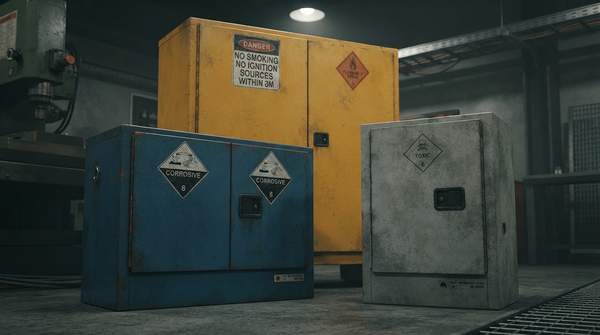
| Flammable solvents | Maximum 1 litre | Maximum 50 litres | Bulk quantities in a metal solvent cabinet | All ignition sources (see next section) |
| Toxic chemicals | Not specified | Not specified | Cupboards, secured where appropriate | Kept contained and minimised in quantity |
| Acids | Not specified | Not specified | Not specified | Bleach and any hypochlorite solutions |
| Bleach (hypochlorite solutions) | Not specified | Not specified | Not specified | Acids — mixing can produce hazardous gases |
Two qualifications matter when reading this framework. The quantity limits apply if larger quantities are stored — many workshops hold only small amounts, where minimisation and common sense govern. And the acid–bleach segregation is absolute: the Cambridge guidance says do not store or use acids with bleach, because mixing these chemicals can produce hazardous gases. The guidance also advises avoiding any agent containing hydrofluoric acid, which is particularly toxic and requires specialised storage beyond a home workshop's scope.