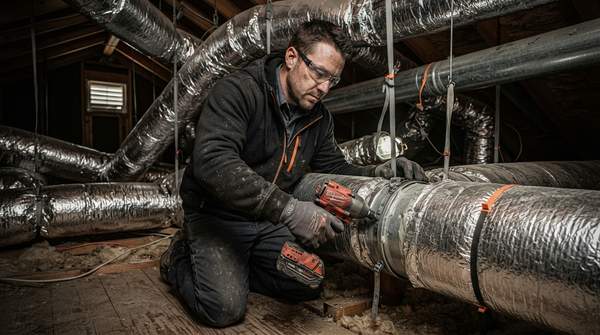
Your ductwork—not your furnace or air conditioner—is often the deciding factor in how much energy your HVAC system wastes and how comfortable your home feels. Engineering guidance is blunt about this: poorly designed or installed ducts cause discomfort, high energy costs, degraded air quality, and excess noise, while a well-designed system delivers comfort at the lowest operating cost. The good news is that many ductwork problems are visible. With a flashlight and a look at your attic, crawlspace, or basement, you can spot red flags like crushed flex duct, uninsulated runs, or leaky joints and decide whether a professional assessment is worth the money.
Why Your Ductwork Matters: Beyond the HVAC Unit
Most homeowners invest in the equipment and ignore the delivery system. An HVAC training text by A. Bhatia makes the point directly: most heating and cooling systems require ductwork to channel conditioned air where it's needed, and "the ductwork can make a big difference in your utility bills." A poor installation job, the same source notes, results in poor performance, bad airflow, leaky systems, and higher-than-usual utility bills.
Bryant, the HVAC manufacturer, uses an analogy that captures the relationship: "If you don't have gas in the car, it won't run. In the same way, if you don't have good ductwork, your HVAC system can't perform the way it's designed to." Without proper sizing, quality installation, and adequate insulation, running an energy-efficient system through poor ductwork is, in that source's words, like "flushing money down the drain."
The Core Principles of Effective Ductwork Design
Duct design is fundamentally about moving a fluid. As building-science writer Allison Bailes explains, air has weight, so every foot of duct and every fitting imposes resistance the blower must overcome. Engineering references state the core requirements plainly: a duct system must convey the specified airflow rates to prescribed locations, be economical in combined initial cost and fan operating cost, and not generate objectionable noise.
Three physical principles follow from that. First, airflow follows the path of least resistance, so hard stops and 90-degree angles create considerable inefficiency, while smooth, gradual transitions keep air moving. Second, ducts must be sized to match the equipment's required airflow—neither so small that the fan strains, nor so large that velocity drops and distribution suffers. Third, the system must be balanced: the return side must bring back as much air as the supply side delivers. Many systems are instead sized by "rule of thumb," a practice flagged in U.S. Department of Energy Building America guidance as common but problematic.