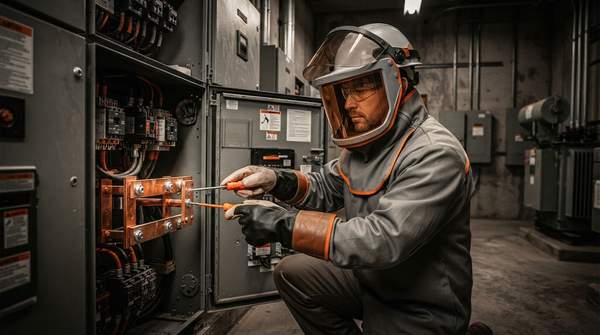
Every circuit breaker in your home's electrical panel does the same basic job: it is an automatic switch that interrupts current flow when it detects a fault, protecting equipment and helping prevent fire. But the breakers in a modern North American panel are not interchangeable. A standard breaker guards against overloads and short circuits, a ground fault circuit interrupter (GFCI) trips on tiny current leaks, and an arc fault circuit interrupter (AFCI) is built to stop fire-causing arc faults. Knowing which type is which—and what hazard each one responds to—is the key to understanding your home's electrical safety system.
The Essential Role of Circuit Breakers in Your Home
A circuit breaker, as Eaton defines it in its fundamentals guide, is an electrical switch designed to protect an electrical circuit from damage caused by overcurrent, overload, or a short circuit. Its basic function is to interrupt current flow after a fault is detected. That interruption is what stands between a wiring problem and the two consequences it can produce: damaged equipment and an electrical fire.
Wikipedia's overview of the device puts the stakes plainly. A breaker's basic function is to interrupt current flow to protect equipment and to prevent fire. Circuit breakers are commonly installed in distribution boards—the panel you may know as your breaker box—and beyond their safety purpose they also serve as manual switches, letting a homeowner or electrician disconnect power to a circuit or an entire sub-network before working on it.
The important conceptual point is that a breaker is a detection device as much as a switch. Something inside it must sense that conditions on the circuit have become dangerous—whether that means too much current for too long, current escaping where it should not, or an arc forming in hidden wiring—and then mechanically open the contacts to cut the circuit. Each breaker type is defined by which of those faults it is built to detect.
Circuit Breakers vs. Fuses: Key Differences
Fuses protect circuits too, and the distinction matters for homeowners. As Wikipedia summarizes it: a fuse interrupts once and then must be replaced, while a circuit breaker can be reset—either manually or automatically—to resume normal operation. That resettability is the practical difference you notice after a trip. When a fuse blows, you need a replacement fuse of the correct rating before the circuit works again; when a breaker trips, you reset the switch.
The reset feature also carries a safety trade-off worth understanding. Because a breaker is reusable, clearing a nuisance trip is quick and cheap, which is part of why breakers became the standard in residential distribution panels. But that same convenience means a breaker can be reset repeatedly into a persistent fault. A tripped breaker that trips again without a clear cause—overloaded appliances, for instance—is a signal that something on the circuit needs attention, not just another reset.
Note that both devices perform the same fundamental protective act: they interrupt current flow to protect equipment and prevent fire. The difference is in what happens afterward. This article focuses on the common single-pole residential breakers found in North American homes; industrial, high-voltage, and smart or IoT breakers follow different designs and are outside this scope.