
Joinery
14 articles
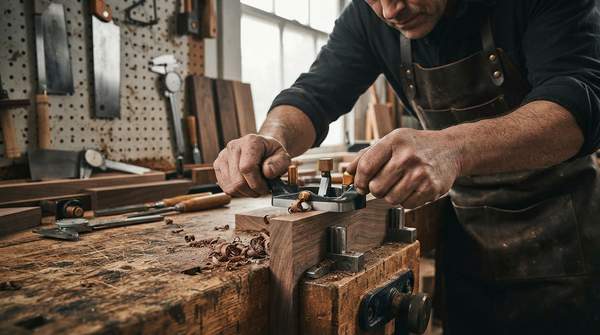
A Woodworker's Guide to Precision: Selecting the Right Hand Tool for Fine Tasks
For superior woodworking craftsmanship, strategically integrate precision hand tools for fine joinery, intricate cuts, and accurate measurements, where power tools often lack the necessary control and tactile feedback.

Essential Beginner Woodworking Joinery Projects
Many aspiring woodworkers spend hundreds on power tools.

Essential Wood Joinery Techniques for DIY Projects
A basic butt joint, easily secured with screws, nails, or glue, is universally considered the weakest wood joint, often leading to premature project failure if used in structural applications.

What Are Common Wood Joints and Their Applications?
In a surprising test, a common dowel joint in solid oak withstood 650 pounds of pressure.

The Science of Wood Joint Strength for DIY Furniture
The strongest joint tested in a lab, a halflap, failed at an astonishing 1603 lbs, challenging many woodworkers' assumptions about durability.

What are basic wood joinery techniques for DIY furniture?
Re-gluing a basic end grain to end grain joint after just a 15-minute pause can increase its strength by over 40%.

What Are Essential Woodworking Joints and How Are They Used?
A basic butt joint, held together by only screws, nails, or glue, is considered the weakest in woodworking, contrasting sharply with the robust, four-sided support of a mortise and tenon joint.

Mortise and Tenon vs. Dowel: Choosing Strong Joints
Mortise and tenon joints consistently outperformed dowel joints by an average of 25% in strength tests, revealing a significant difference in structural integrity.

What Are Mortise and Tenon Joints and Why Are They So Strong?
In controlled tests, mortise and tenon joints consistently outperformed dowel joints by an average of 25%, revealing a significant difference in structural integrity.

Essential Woodworking Joints for DIY Projects
A common butt joint, often seen in beginner woodworking projects, is so inherently weak it frequently results in a 'glue-starved' connection destined to fail, according to Canadianwoodworking .

What Are Common Woodworking Fasteners and How Do They Resist Force?
Even a perfectly engineered beam can fail if its fasteners are under-tightened by just a few degrees, or over-tightened to the point of material stress.

Mortise and Tenon vs. Dowel & Biscuit: Which Is Stronger?
In a comprehensive test by Canadian Woodworking Magazine , common dowel and biscuit joints were put head-to-head against the ancient mortise and tenon, revealing stark differences in their ability to

A Guide to the Types of Joinery in Woodworking Explained
Discover the fundamental skill of woodworking joinery and how different joint types impact a project's strength, durability, and appearance. This guide explains common joints, their uses, benefits, and drawbacks to help you build lasting pieces.

Choosing the Right Woodworking Joint: A Beginner's Decision Guide
This guide helps beginners choose the right woodworking joints by balancing project needs, available tools, and skill levels. It covers joint types for case construction, furniture, and reinforcement methods, emphasizing strength from interlocking geometry and glue surface.